Showing posts with label canning. Show all posts

28 November 2009

grapefruit-hibiscus marmalade


Take six grapefruit. Remove the outer peels, leaving behind the pith.


Julienne the rind. This sounds arduous, but it's worth it. And less work that one might expect.

Take off the rest of the rind. Section the grapefruit, making sure to save the pith and seeds for the pectin bag. Do the same with one lemon. Measure the fruit. (I had two pounds). Tie the membranes and seeds in cheesecloth.


Cook the fruit, with the pectin bag and peels on top, for twenty minutes. (Add a splash of water if needed.) Then add an equal weight of the fruit (before rind) in sugar to the pot.


Add one half-cup of dried hibiscus flowers.


Cook on medium-high until it starts to thicken. Remove the pectin bag.


Squeeze out the thick pectin-filled goo — or press well in a conical strainer (less of a chance of burning yourself). Add that to the marmalade and cook until about 8º above boiling (220º unless you're at a high elevation).


And/or test by dropping onto a plate that has been in the freezer.


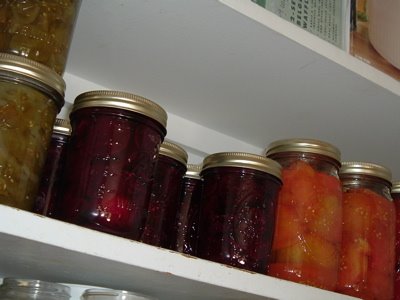
Place in sterilized jars. Process in a hot-water bath for 5 minutes.


And here it is. It's bracing, perfect for breakfast toast. My favorite marmalade yet.

quince preserves


Been on an obvious quince kick lately. And when it comes to fruit, I Jane Grigson's Fruit Book never lets me down. She suggests a quince jelly where one chops the less handsome fruit into small pieces and reserves the nicer quince for slicing.


This pot (above) is filled with chopped whole quinces, then the cores and skins of the nice quinces, and then finished with the elegant quince slices. I also added four star anise, a few allspice berries, a sliced lemon and a half vanilla pod.


Once poached and soft, they are removed.


The rest comes to a hard boil and is mashed up. Once very soft, it gets passed through jelly cloth. I used a food mill and then a conical strainer to extract more, giving a more jamlike texture.


That gets cooked with the sliced quince and 2¼ cups of sugar for each 2 cups of liquid (before adding the slices).


Cook until it jells when placed on a cold plate. This happened around 220º, similar to a marmalade.


I processed these in a hot water bath for six minutes (always use Putting Food By as a reference). Nice texture, softer than membrillo, but more coarse than jelly. Very good. And star anise was a good idea. It's subtle, but highlights the quince flavor.

23 February 2009

blood orange marmalade


So a year ago when I tried this — and had great results — I didn't take any notes or leave any details in the blog post. So I had to start from scratch. And marmalade recipes vary greatly in method and proportions. Some have you slice the fruit and pick out the pips; June Taylor cuts the rind into triangles (which I tried and didn't like as much) and it appears that she candies the rind first; some have you juice the fruit and then chop the rind. Most have you hold the pips (and often membranes) for pectin (except the ones that use commercial pectin, which seems ridiculous). Worse, sugar ranges from about one-to-one to thrice(!) the quantity of fruit. Some measure the fruit in quantity, or weight, or juiced-and-peeled volume. It's overwhelming.

So I had a half dozen blood oranges that were really too bitter to eat. And then some lovely Meyer lemons to balance that out. I peeled the rind off of three Meyer lemons and juiced them: the rest I held back for the pectin bag. I cut the rind into strips about an eighth of an inch wide. I juiced the blood oranges very well, leaving very little membrane left inside. I cut those in the same manner. All the pips and membranes went into cheesecloth and was tied up (that's where most of the pectin is). I used about an equal weight of fruit and sugar.

I cooked the fruit and pectin bag for about twenty minutes to soften the fruit and then added the sugar. After fifteen minutes I took out the pectin sack and let it cool enough to squeeze out all that pectin. I cooked the marmalade until it jelled just enough on a saucer placed in the freezer, which was about 222ºF (and most recipes suggest 8º-10ºF above boiling). This was even more red than last time, and has great flavor. I might even use a tiny bit less sugar next time, but only as I like marmalade on the bitter side.

27 July 2008

ginger-melon jam


I got two wonderful, striped, orange-fleshed (and still unidentified* — I should have taken a photo) melons from the CSA this week. I ate the first one in about twenty-four hours it was so good. Looking through Jane Grigson's Fruit Book, I found a recipe for Melon and Ginger Jam. A very simple recipe, adapted from hers:

For each 2lbs cubed, peeled, melon (about one melon):
  • 2lbs sugar (I use organic in preserves, usually)
  • Rind and juice of 3 lemons
  • Ginger, grated fine (maybe 5-7 inches?) (Grigson uses preserved ginger)


The fruit sits overnight with the sugar at room temperature (first picture). I then added the ginger and lemon and cooked it until it started to set when cooled on a small dish. I mashed the fruit with a potato masher for a more even consistency (melon holds up quite well to cooking, which surprised me).

The lemon flavor mellows and mostly highlights the melon flavor and the ginger gives it a wonderful kick. I am very happy with the results.

2 lbs fruit yielded 3 pints (3 half-pint and six quarter-pint jars).


* n.b. (13 August) : The melons have been identified as "Early Queen".

14 July 2008

currant jelly

I planted a red currant bush at my parents' house when I was a kid. Naturally, its most fruitful time has been since I've no longer been there. My parents dropped off about two pounds, so I made jelly (referring to Jane Grigson's Fruit Book as well as the preserving manual Putting Food By) :


Ingredients: just equal parts (weight) currants and sugar.

Grigson says to boil hard, then boil for 8 minutes. Sounds vague. I do like that she leaves the fruit whole (even suggests not taking out stalks) and then straining it. Putting Food By suggests making currants juice, then making jelly. That seemed to troublesome. But they direct one to boil until 8ºF above boiling.

I boiled the currants and sugar until they were at 220ºF, whisking at one point to make sure that the fruit was all broken. I strained it through a sieve and got 5 ½ pint jars. [n.b.: hot water bath for 6 mins.] It's tart and deep, deep red.

03 March 2008

sweet.

I've been enjoying the cookbook Breakfast•Lunch•Tea, a cookbook companion to Rose Carrarini's Rose Bakery in Paris. Her biscuits (cookies) that I've made have been nicely not to sweet, which is refreshing. (I made a bunch of the gingerbread biscuits around the holidays). This is her lemon cake. It's a pound cake of sorts, but not quite. I halved the recipe and put it in kougelhopf mold:

125 g. butter / 100 g. sugar / 2 eggs / ½t. vanilla / juice of ½ a lemon (I used a whole meyer lemon, since it's a little smaller) / zest of one lemon / ½ rounded t. baking powder / ¼ t. salt / 25 g. ground almonds / 140 g. AP flour.

The butter and sugar get creamed, the eggs beat in, then the vanilla and lemon juice and zest. the dry ingredients are folded in and it gets bakes for 25-30 minutes at 350ºF.


And last night I made blood-orange meyer lemon marmalade. I found both fruits on sale and organic so it seemed like I needed to find a great use for those rinds. It was really great for breakfast, on toast.

23 September 2007

tomato season

It's that time of the year when there's so much food that's fresh and local that it's overwhelming. Part of this is that you know that in a month it could be snowing.

Between this week and last I've bought and used forty pounds of plum tomatoes, twelve pounds of cabbage and all sorts of other wonderful things. The tomatoes ended up as a tomato tarte tatin (no photo! and it was the best I've made!), twenty-two pints of canned tomatoes and probably twelve or thirteen pints of sauce (we had a housewarming that involved the tatin and lots of sauce with fresh pasta and olives). Best of all, forty pounds of fresh local tomatoes for a total of $25.

Sauerkraut is fermenting in the back room in what was the best birthday present ever: a two gallon "bluebird" crock. All twelve pounds of cabbage made it in there and it's now covered in it's own brine. (I only added salt, juniper berries and caraway seeds). It doesn't taste like it's there yet, but it's only been a week.

And that delicious savoy cabbage in the photo made it into a great Deborah Madison creation: savoy cabbage sautéed with lacinato kale and white beans. Very very satisfying.

30 September 2006

week's end...


A week (and then some) of canning comes to a close. Off to New Jersey and Delaware with Luke -- so canning, cooking and the like can be held at bay until Friday (at the earliest). Made a nougatine tart at work for the "demo" -- the small convection oven, as much as it is small, defies the "middle rack" logic and the almonds were carmalized (read burned, but everyone loved it). One coworker declared it her new favorite dessert. Who wouldn't? Almonds, apples sautéed in butter, a flaky crust... it's a whole lot of heaven.

green tomatoes

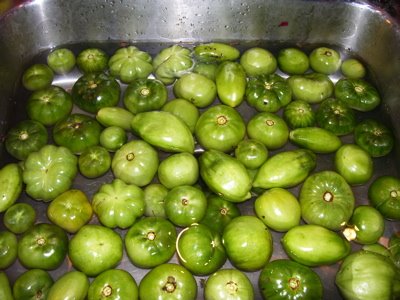
Last weekend I made tomato pickles as the CSA has tons ofgreen tomatoes that have been rotting before going red somehow. Jonathan and I picked 30 pounds or so of green tomatoes, from roma to green zebra... Washed them, cored and sliced them and layerd them with salt an onions. They brined overnight, and in the morning I simmered them with yellow and black mustard seeds, peppercorns and a few cloves for thirty minutes before canning them.

Julie and I had some last night. Sweet, tart and very mustardy. I need to try again with some hot peppers.